Tools You’ll Need
• Measuring tape or a ruler
• A flat, stable surface
• Safety gloves (to handle the blade safely)
- Disconnect the spark plug to ensure the mower won’t start accidentally.
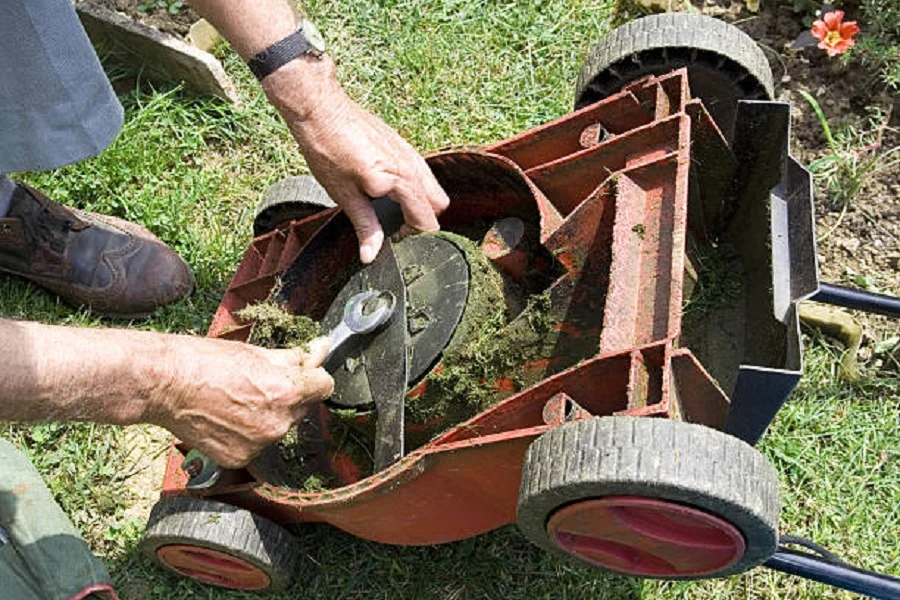
- Use a wrench to loosen the bolts holding the blade in place.
- Carefully remove the blade, wearing gloves for safety.
- Wipe away any dirt, grass clippings, or rust using a damp cloth.
- This ensures accurate measurements and allows you to inspect the blade’s condition.
- Avoid measuring along the straight edge or parallel sides, as this will give you an incorrect size.
- Place the blade flat on your surface.
- Record the measurement, rounding to the nearest inch or fraction depending on your mower’s specifications.
- Note this width, as it helps ensure the blade fits within your mower’s deck.
- Most mower blades have a center hole for mounting. Use your measuring tape or ruler to determine the diameter of this hole, as it’s vital for compatibility with your mower.
- Some blades have additional outer holes for securing the blade; measure these distances if applicable.
Tips for Accurate Measurement
- Double-check your measurements to ensure accuracy.
- Consult your mower’s manual to confirm the blade size recommendations.
- Always use a flat, even surface for measuring to prevent errors.
| Measurement Type | What to Measure | Why It’s Important |
| Blade Length | Diagonal distance from tip to tip | Ensures compatibility with mower size |
| Blade Width | Perpendicular distance across the widest part | Checks clearance within the mower deck |
| Center Hole Diameter | Diameter of the mounting hole | Ensures proper installation onto the mower |
Common Mistakes to Avoid
- Forgetting to Measure the Center Hole: Even if the blade length matches, an incorrect center hole size can make the blade unusable.
- Ignoring Safety Precautions: Always handle blades with care, as even dull blades can cause injury.
Proper measurements also help avoid unnecessary returns and wasted time. Follow these steps to keep your mower working optimally.
Why Measure Diagonally?
Measuring diagonally provides the most accurate representation of the blade’s actual length. Lawn mower blades are not straight, flat pieces of metal—they often have curves, cutting edges, and other design features.
Tools You’ll Need
- A tape measure or ruler (ensure it measures in inches, as most blades are measured in imperial units).
- A flat, stable surface to place the blade.
- Safety gloves to protect your hands from sharp edges.
Step-by-Step Guide to Measuring Diagonally
- Disconnect the spark plug to prevent accidental starts.
- Use a wrench to loosen and remove the blade from the mower. Ensure you secure the mower to avoid tipping during this process.
- Lay the Blade on a Flat Surface
Place the blade on a flat, even surface to prevent measurement errors caused by curves or uneven areas. - Be sure the tape measure stretches in a straight diagonal line, capturing the entire span from corner to corner.
- Record the Length
Note the measurement in inches, as this will help you determine the compatibility of a replacement blade.
| Blade Length (inches) | Common Application |
| 16–18 inches | Small push mowers |
| 20–22 inches | Standard walk-behind mowers |
| 30+ inches | Riding mowers or zero-turn mowers |
Tips for Accurate Measurements
- Ensure the blade is clean before measuring. Dirt or grass buildup can interfere with precision.
- If the blade is heavily worn or chipped, you may need to estimate the original length based on its design.
By measuring diagonally, you’re ensuring the most precise results. This method is essential for finding the correct replacement blade, improving mower performance, and maintaining a well-groomed lawn.
Lawn Mower Blade Center Hole Types
The center hole is the connecting point where the blade attaches to the mower’s spindle, so choosing the correct type is essential for proper installation and operation. There are several common center hole designs, each tailored to specific mower models. Below, we’ll explore the most common types and tips for selecting the right one.
Common Lawn Mower Blade Center Hole Types
- The most frequently used type for residential mowers.
- Typically found on push mowers and smaller riding mowers.
- Available in various diameters, such as 5/8 inch or 7/8 inch.
- Designed with a star pattern, usually with 5 or 6 points.
- Provides improved grip and security to prevent slippage.
- Common on both residential and commercial-grade mowers.
- Features a bow-tie-shaped opening for specialized mower models.
- Less common but used by some specific mower brands.
- Offers a secure fit for precision cutting.
- Shaped like the letter “D” with one flat side and a rounded edge.
- Designed for mowers requiring additional stability during operation.
- Often found on heavy-duty or commercial machines.
- Longer, rectangular opening designed to accommodate specific mower setups.
- Often compatible with older or niche mower models.
How to Identify Your Blade’s Center Hole Type
Properly identifying your blade’s center hole type is an important step when replacing or upgrading your mower blades.
- Inspect the Existing Blade: Remove the current blade and note the shape of the center hole. Compare it with the types listed above to determine compatibility.
- Check Your Mower Manual: The manufacturer’s manual will often include specifications on blade requirements, including center hole type and size.
- Measure the Diameter (if applicable): For round holes, measure their diameter using a ruler or caliper to ensure precision.
Compatibility Tips
- Always purchase blades that match your mower’s design specifications, including center hole type and size.
- If unsure about compatibility, bring your old blade to a hardware store or consult an expert for assistance.
- Avoid forcing a mismatched blade onto your mower as it can result in safety risks and equipment damage.
Table of Common Center Hole Types and Uses
| Center Hole Type | Common Use Cases | Key Features |
| Round | Push mowers, residential use | Simple design, multiple sizes |
| Star-Shaped | Residential & commercial-grade mowers | Strong grip, reduced slippage |
| Bow-Tie | Specialized mower models | Unique shape for secure fit |
| D-Center | Heavy-duty applications | Added stability |
| Rectangular/Elongated | Older/niche mowers | Accommodates specific designs |
Lawn Mower Blade Center Hole Types
The center hole is where the blade attaches to the mower’s spindle, so matching this feature correctly ensures a secure fit and proper functioning of your equipment.
Common Center Hole Types
Lawn mower blades come with various center hole designs, each tailored to fit specific makes and models.
- Found in many standard residential mowers.
- Requires a snug fit on a round spindle bolt or adapter.
- Features five protruding points around the edge of the center hole.
- Common in some newer models and select brands.
- Ensures secure alignment during operation.
- Similar to its five-point counterpart but with an extra star point for added stability.
- Typically used in specific mower models by select manufacturers.
- Unique, bow-tie-shaped opening designed for compatibility with particular mounting assemblies.
- Often found in mulching or high-performance blades.
- A simple rectangular or square opening that fits over similarly shaped spindles.
- Common in older mowers or specialized equipment.
How to Identify Your Blade’s Center Hole Type
- Remove and Inspect Your Current BladeCompare it visually to standard shapes like round, star, or bow-tie designs.
- Measure Dimensions if Needed: For non-standard holes (e. g. , rectangular), you may need to measure dimensions such as length and width for an exact match.
- Check Brand-Specific Features: Some manufacturers use proprietary designs that only work with their blades; make sure any replacement is compatible with your mower’s brand and model.
Table: Quick Overview of Common Center Hole Types
| Center Hole Type | Shape Description | Common Use Case |
| Round | Circular | Standard residential mowers |
| Five-Point Star | Five-pointed star | Many modern mowers |
| Six-Point Star | Six-pointed star | High-stability configurations |
| Bow-Tie | Bow-tie shaped | Mulching/high-performance blades |
| Rectangle/Square | Rectangular/square | Older models/specialized equipment |
Practical Tips for Choosing Replacement Blades
- Purchase from reputable suppliers who specialize in lawn equipment parts.
- Bring your old blade when shopping locally so store staff can help match it accurately.
- Double-check that mounting hardware like bolts or adapters are included if needed for installation.
Right-Hand Cut vs Left-Hand Cut Blades
These distinctions impact how the blade rotates, cuts grass, and fits on your machine. Selecting the wrong type can result in improper cutting performance or damage to your mower.
Key Differences Between Right-Hand and Left-Hand Cut Blades
| Feature | Right-Hand Cut Blades | Left-Hand Cut Blades |
| Blade Rotation Direction | Rotates clockwise (when viewed from above) | Rotates counterclockwise (when viewed from above) |
| Grass Discharge Direction | Typically discharges grass to the right side of the mower | Typically discharges grass to the left side of the mower |
| Mounting Orientation | Designed for mowers with a right-turning spindle shaft | Designed for mowers with a left-turning spindle shaft |
How to Identify Blade Type
- Inspect the Blade Edge:
Examine the sharpened or beveled edge of your blade. For a right-hand cut blade, the cutting edge is on the right when holding the blade with its center hole facing you. For a left-hand cut blade, it’s on the left. - Check Mower Specifications:
Your manufacturer’s manual will specify whether your mower requires a right- or left-hand cut blade. This information is crucial before purchasing a replacement blade. - Observe Mower Rotation:
If unsure, observe how your current blade rotates during operation. Clockwise rotation indicates a need for a right-hand cut blade, while counterclockwise rotation means you’ll need a left-hand cut blade.
Common Uses of Each Blade Type
Right-hand cut blades are far more common in residential lawn mowers, as most machines are designed for clockwise rotation. These include push mowers, zero-turn mowers, and riding lawn mowers from popular brands like John Deere, Husqvarna, and Toro.
Left-hand cut blades are less common but are typically used in specific commercial-grade equipment or certain models of walk-behind and ride-on mowers.
Practical Tips for Choosing and Installing Blades
- Double Check Compatibility:Always refer to your mower’s manual or consult with your manufacturer to ensure compatibility between your mower and chosen blade type.
- Avoid Guesswork:If you’re unable to identify whether your existing blade is right-hand or left-hand cut, remove it and take it to your local hardware store or an experienced technician for guidance.
- Proper Installation:Ensure you mount blades in the correct orientation. Installing them upside down or on the wrong type of spindle can result in poor performance and potential safety hazards.
By understanding and correctly identifying whether you need right-hand or left-hand cut blades, you can maintain optimal lawn mower performance while achieving an even, clean-cut lawn every time. Proper selection and installation also extend the lifespan of your mower and prevent unnecessary wear and tear.
Measuring Your Mower Blade’s Width
The blade width plays an important role in cutting efficiency, balance, and compatibility with your mower. Below is a guide to accurately measure your mower blade’s width and understand its significance.
Why Measuring Blade Width Matters
- Fit and Compatibility: Mismatched blade widths can cause uneven mowing or even damage to your mower.
- Cutting Performance: The width affects the blade’s reach and its ability to cover a specific swath of grass in one pass.
- Balance and Safety: Using a blade with the wrong width may result in vibrations, uneven cuts, or undue stress on the mower.
Tools You’ll Need
- A tape measure or ruler
- A flat surface to lay the blade on (such as a workbench or table)
- A clean cloth (to remove dirt or grass clippings for accurate measurement)
Step-by-Step Guide to Measuring Blade Width
- First, safely detach the blade from your mower. Refer to your mower’s manual for disassembly instructions. Always wear gloves to protect your hands from sharp edges.
- Lay the blade flat on a clean, even surface.
- Note that the blade may taper towards the ends, so ensure you’re measuring at the widest section.
- Record the measurement in inches or millimeters, as preferred.
Common Blade Width Ranges
| Mower Type | Blade Width Range |
| Push Mowers | 1.5″ to 3″ |
| Riding Mowers | 2″ to 4″ |
| Commercial Mowers | 3″ to 5″ |
Note: Always confirm your mower’s specific requirements in its manual or manufacturer guidelines.
Tips for Accurate Measurements
- Check for bends or warping in the blade. A bent blade may give inaccurate measurements and should be replaced rather than measured.
- Use a ruler with clear markings to avoid errors.
- If possible, measure twice to ensure precision.
Signs Your Blade Width May Be Incorrect
- Excessive vibration during operation: This could indicate an improperly sized or unbalanced blade.
- Difficulty attaching the blade: If the bolt holes don’t align properly, you may have chosen a blade that’s too wide or narrow.
Always consult manufacturer specifications when replacing blades to maintain compatibility and safety.
- Chips, cracks, or bends in the blade are strong indicators that replacement is needed.
- If sharpening no longer restores the blade’s edge, it’s likely too worn for continued use.
- If you notice patches of uncut grass or the mower is struggling to cut evenly, it may be time for new blades.
- Over time, repeated sharpening and exposure to debris can thin the blade. A thin blade is weaker and more likely to break.
| Type of Mowing | Expected Blade Lifespan |
| Regular Residential Use (small yard) | 1-2 seasons |
| Large Property or Commercial Use | 1 season or less |
| Rocky or Debris-Filled Yards | Shorter lifespan, frequent replacement |
If you mow often or encounter rough terrain, you may need to replace blades more frequently.
Tips for Extending Blade Life
- Inspect Blades Regularly
Check for damage or dullness after every 8-10 hours of mowing. - Sharpen Blades as Needed
Sharpening your blades every 20-25 hours of use can help maintain cutting efficiency. - Avoid Mowing Over Debris
Stones, sticks, and other debris can cause severe damage to the blade’s edge.
Consequences of Using Worn Blades
Failing to replace worn or damaged blades can lead to:
– Uneven Grass Cuts
Resulting in an untidy lawn and potential grass health issues.
– Increased Fuel Consumption
Dull blades force the engine to work harder, using more fuel.
– Potential Lawn Mower Damage
A damaged blade can unbalance the mower, leading to premature wear on the engine and deck.
Always follow your lawn mower’s manual for specific blade replacement guidelines.