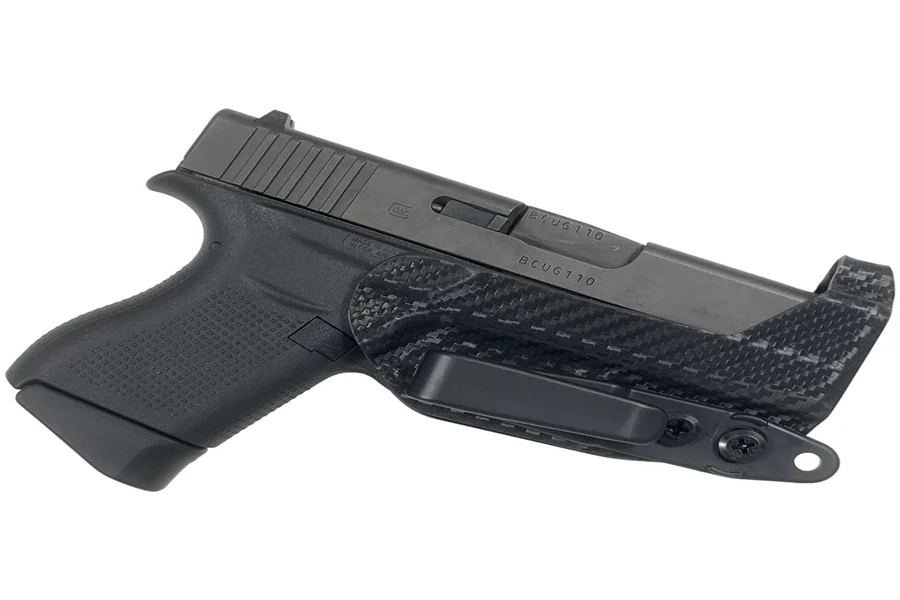
Types of Glock 43 Holsters
Inside-the-Waistband (IWB) Holsters
- Description: IWB holsters are designed to be worn inside the waistband of your pants, offering excellent concealment. They are a popular choice among concealed carry users due to their discreet profile.
- Superior concealment, ideal for everyday carry (EDC).
- Comfortable with proper positioning and adjustment.
- Compatible with various clothing styles.
- May feel restrictive if not worn correctly.
- Requires a high-quality gun belt for support.
Outside-the-Waistband (OWB) Holsters
- Description: OWB holsters rest on the outside of your waistband and are commonly used for open carry or situations where concealment is less critical.
- Easier access to your firearm compared to IWB options.
- Comfortable due to less contact with skin or clothing.
- More challenging to conceal without layering clothing over them.
- May not be suitable in warmer climates where lighter clothing is used.
Appendix Inside-the-Waistband (AIWB) Holsters
- Description: AIWB holsters are a variation of IWB models but positioned at the front of the body near the appendix area.
- Faster draw speed due to gun placement in a natural position.
- Potentially higher comfort based on individual body type.
- Offers great concealment when paired with appropriate attire.
- Can feel uncomfortable while seated if not adjusted properly.
- Requires practice for safe reholstering.
Pocket Holsters
- Description: Pocket holsters allow you to carry your firearm inside a pocket while keeping it secure and oriented correctly.
- Extremely discreet option for deep concealment purposes.
- Lightweight and easy to carry in most casual settings.
- Slower draw time compared to other options since accessing from the pocket can take longer.
- Limited compatibility depending on pocket size or clothing choice.
Shoulder Holsters
- Description: These are harness-style holsters that hang under one arm and are secured across both shoulders, making them suitable for carrying larger firearms or when sitting long periods, such as during travel.
- Pros:
- Great option while driving or seated for extended periods.
- Reduces pressure at waist level, which can be beneficial during long-term wear.
- Provides alternative positioning compared to waist-mounted options.
- Cons:
- Requires proper adjustment; otherwise, movement may feel restricted.
- Less popular among concealed carriers due to visibility under light layers.
Ankle Holsters
– Description: Worn around the ankle, these holsters work well as backup-carry solutions rather than primary ones pros.
How to Choose a Glock 43 Holster
Selecting the right holster for your Glock 43 is crucial for ensuring safety, comfort, accessibility, and durability. With so many options available, it can feel overwhelming to narrow down your choices. Here are the essential factors to consider when choosing the perfect Glock 43 holster.
1. Carry Position
- Inside-the-Waistband (IWB): Ideal for concealed carry as it tucks inside your pants and offers excellent concealment.
- Outside-the-Waistband (OWB): Better for open carry or those looking for quick access during range practice.
- Appendix Inside-the-Waistband (AIWB): A subset of IWB that sits in front of the body near the appendix area, offering ease of access but requiring proper training.
- Ankle Holsters: Useful as a backup option but less accessible compared to waist-mounted styles.
- Pocket Holsters: Designed specifically for deep concealment in jacket or pant pockets.
Consider where on your body you’re most comfortable carrying and match it with an appropriate holster style.
2. Material Options
| Material | Pros | Cons |
| Kydex | Durable, lightweight, rigid retention | Can be less comfortable against skin |
| Leather | Comfortable and molds to firearm over time | Requires maintenance; less moisture-resistant |
| Nylon/Fabric | Lightweight and affordable | Less durable compared to Kydex or leather |
For many users, Kydex is often favored due to its ruggedness and consistent retention properties. However, leather remains a popular option among those who prioritize comfort during extended wear.
3. Retention Features
- Passive Retention: Uses friction to hold the firearm securely in place without additional mechanisms.
- Active Retention: Includes mechanisms like thumb breaks or locking devices that add an extra layer of security.
Decide whether you prefer the simplicity of passive retention or the added security provided by active retention systems.
4. Adjustability
Many modern holsters offer adjustable cant (angle), ride height (position on the belt), and retention pressure. These features allow you to customize how your Glock 43 sits on your body and its draw resistance based on personal preferences.
5. Safety Considerations
A good holster must completely cover the trigger guard to prevent accidental discharge while carrying or drawing your firearm. Additionally, select a model designed specifically for Glock firearms rather than “universal” fits that risk improper alignment.
Practical Tips When Shopping:
- Test different styles whenever possible before committing to one model.
- Check user reviews specific to Glock 43 compatibility.
- Invest in quality over price—your safety depends on it.
- Consider specialized models if adding accessories like red dot sights or extended magazines.
Making an informed decision requires balancing personal preference with practical functionality—always prioritize safety above all else when selecting a holster for daily use with your Glock 43.
How We Test the Best G43 Holsters
When evaluating the best Glock 43 holsters, it’s essential to take a systematic and thorough approach. A holster’s quality and performance can greatly impact safety, comfort, and overall shooting experience. Here’s how we break down our testing process to ensure you get an accurate assessment of each product.
Criteria for Testing
- Does the holster securely hold the Glock 43 in place?
- Is there an adjustable retention system for personalized fit?
- Can it withstand movement or vigorous activity without losing grip on the firearm?
- Does the holster sit comfortably against the body during extended wear?
- Are there any pressure points or areas causing discomfort during movement?
- Is it lined or padded to reduce skin irritation?
- How well does the holster minimize printing when worn with standard clothing?
- Is it suitable for different carry positions (IWB, OWB, AIWB)?
- What materials are used in construction (e.g., Kydex, leather)?
- Does it resist wear and tear over time, especially with daily use?
- Are rivets, stitching, or clips built to last under stress?
- Can you draw your Glock swiftly without obstruction?
- Does the angle (cant) allow for a natural draw motion that complements muscle memory?
Testing Methodology
- Fit and Compatibility Check
Each holster is tested with multiple Glock models to ensure compatibility specifically with the G43. We assess if customization options like adjustable cant or ride height improve its performance. - Field Scenarios Simulation
We simulate everyday activities like walking, sitting in cars, bending over, or running to test retention strength and comfort. This ensures practical performance under various real-life conditions. - Stress Testing
Materials are subjected to extreme conditions such as high heat, cold temperatures, moisture exposure, and rough handling to check durability. - Timed Draw Exercises
To measure speed and ease of access under pressure, we conduct timed drawing tests from various carry positions using standardized drills. - Long-Term Wear Review
Volunteers wear-test each holster daily for up to two weeks while documenting comfort levels over time. This helps identify issues like fatigue caused by weight distribution or material stiffness.
Scoring System
| Criterion | Weight (%) | Example Considerations |
| Retention/Security | 30% | Adjustable retention screws; firm fit |
| Comfort | 25% | Padding; ergonomic design |
| Concealability | 20% | Slim profile; reduced printing |
| Durability | 15% | Weather resistance; material lifespan |
| Ease of Draw | 10% | Smooth angle; minimal obstructions |
This scoring provides an unbiased comparison between products so readers can make informed decisions when choosing their Glock G43 holster.
Feedback Collection
Finally, user feedback is collected from gun owners who test these products in everyday situations. Their insights complement our testing by highlighting how well these holsters adapt to different lifestyles or carry preferences.
By adhering to this rigorous process focused on practicality, safety, and durability factors, we ensure only top-performing Glock G43 holsters make our list of recommendations.
How We Test the Best G43 Holsters
1. Fit and Retention
A perfect fit for the Glock 43 is crucial for both safety and usability. During testing:
– We check whether the holster snugly secures the firearm without excessive force required to draw or reholster it.
– Retention mechanisms (such as passive retention systems or active locking devices) are evaluated to ensure they hold the firearm securely during movement, including running or bending over.
2. Comfort Assessment
Comfort is paramount for daily carry, especially with Inside-the-Waistband (IWB), Appendix IWB (AIWB), or even Outside-the-Waistband (OWB) holsters. Key factors we consider include:
– Material quality: Soft edges to prevent irritation against the skin during extended wear. Leather, Kydex, or hybrid materials are tested for comfort under various conditions.
– Adjustability: Belt clip positions, ride height, and cant adjustments are examined to allow customization based on body type and personal preferences.
3. Concealment Testing
For concealed carriers, minimizing printing (visible outlines of a firearm through clothing) is essential:
– Holsters are tested with different types of attire—casual T-shirts, dress shirts, jackets—to monitor concealment performance across settings.
– Special attention is paid to AIWB designs due to their popularity in concealed carry scenarios.
4. Drawing Speed & Accessibility
Quick access can be critical in an emergency situation:
– We test draw speeds from each holster type while wearing everyday attire to simulate real-world conditions. – Holsters are also evaluated for their reholstering ease without needing two hands.
5. Durability under Stress
Holsters must withstand daily use without degrading in performance:
– Each holster undergoes stress tests such as exposure to extreme temperatures (hot and cold), moisture resistance simulations (sweat/water), and extended wear over time. – Materials like Kydex are scrutinized for cracking or warping while leather options are inspected for signs of stretching or weakening stitches.
Testing Summary Table
| Feature | Evaluation Criteria | Example Tests | Importance Level |
| Fit & Retention | Secure hold without difficulty drawing | Shake test; retention adjustments | High |
| Comfort | Material feel; lack of irritation | Full-day wear | High |
| Concealment | No printing under minimal clothing | Worn under T-shirts/jackets | Medium-high |
| Drawing Speed | Quick deployment without snags | Timed draws from concealment | High |
| Durability | Longevity under typical and extreme conditions | Temperature/moisture exposure | Medium |
Testing ensures that only top-performing G43 holsters earn recommendations based on real-world practicality and high standards for everyday use. By prioritizing these factors during evaluations, you can trust that each product meets strict requirements suited specifically for Glock 43 owners’ needs—not just theoretical claims by manufacturers but proven reliability through real-world testing methods.
How We Test the Best G43 Holsters
Selecting the best holsters for the Glock 43 requires a thorough and meticulous process to ensure they meet high standards of comfort, durability, functionality, and concealed carry effectiveness. Each holster is assessed based on specific criteria to provide users with practical and reliable guidance. Below is an overview of how we approach testing and evaluating G43 holsters.
Key Evaluation Criteria
- Ability to effectively hide the firearm under various clothing types (t-shirts, jackets, formal wear).
- Assessment of printing or firearm outline visibility during movement or different body positions.
- Testing for all-day wear to see if the holster causes irritation or discomfort.
- Evaluation of how well it adapts to different body shapes and sizes.
- Ensuring that the firearm remains securely in place during physical activity such as walking, jogging, or bending over.
- Testing adjustable retention features (if available) for ease of customization and reliability under stress.
- Exposure to daily wear-and-tear conditions such as sweat, temperature changes, or extended use over weeks.
- Material quality checks—for example: Kydex rigidity versus leather flexibility over time.
- Smoothness of drawing the Glock 43 without snagging or excessive resistance.
- Ability to reholster quickly without looking down, critical during high-pressure situations.
- Compatibility with various carry positions (IWB, OWB, AIWB).
- Usability for both right-handed and left-handed users when applicable.
Holster Testing Methods
- Real-World Carry Scenarios: Holsters are tested in everyday environments such as running errands or sitting in vehicles to mimic real-life usage.
- Stress Testing: Simulated physical activities like jogging or jumping help assess retention strength and overall stability.
- Wardrobe Testing: Each holster is paired with different outfits ranging from casual t-shirts to business attire.
- Time Trials: Measuring speed and efficiency for drawing the Glock 43 under timed conditions ensures practicality in urgent situations.
Test Environment Highlights
| Environment | Purpose | Example Activities |
| Urban/City Settings | Assess concealment in crowded areas | Walking in busy streets |
| Outdoor Spaces | Test retention under active movement | Hiking or jogging |
| Vehicle Settings | Evaluate comfort while seated | Driving long distances |
Feedback from Users
Beyond controlled testing environments, feedback is collected from experienced gun owners who use these holsters daily. This provides real-world insights into long-term satisfaction while highlighting potential issues that may not arise immediately after purchase.
By combining standardized evaluations with practical feedback from users across diverse scenarios, we aim to recommend only those G43 holsters that excel across all critical parameters—keeping your safety and comfort as top priorities while carrying your firearm discreetly and confidently.
How We Test the Best G43 Holsters
1. Comfort and Concealability
The primary goal of any Glock 43 holster is to strike a balance between comfort and effective concealment. To assess these factors:
– Daily Wear Testing: Each holster is worn for extended periods by testers of different body types to assess long-term comfort.
– Concealment Analysis: We evaluate how well the holster prevents printing (the outline of the firearm showing through clothing) using varying wardrobe styles such as T-shirts, button-ups, and jackets.
Factors considered:
– Padding or lining material for skin comfort during prolonged wear.
– Adjustability options like cant angle (tilting of the firearm) or retention settings, which help tailor concealment based on carry style.
2. Retention and Firearm Security
A high-quality G43 holster should secure your firearm without compromising accessibility. During testing:
– The trigger guard’s coverage is closely examined for safety against accidental discharge.
– Holsters are subjected to shake tests where testers simulate quick movements such as jogging or bending over, ensuring that firearms remain securely in place.
Holsters with adjustable retention screws are compared to determine how customizable security levels impact usability.
3. Ease of Access and Draw Speed
For those using their Glock 43 for self-defense, quick access is critical:
– Testers practice drawing from each holster under real-world scenarios—standing, sitting in a vehicle, or under stress simulations—to measure draw speed and ease of re-holstering. – Holsters designed with audible click retention systems are tested for their reliability when drawing rapidly.
Metrics measured:
– Average draw time from concealed carry position (IWB/AIWB/OWB).
– Accessibility under layered clothing or jackets.
4. Durability Testing in Various Conditions
Glock users often seek gear that functions reliably across diverse environments—whether at home or outdoors:
– Holsters undergo environmental testing with exposure to dust, rain, heat, and cold conditions to mimic real-life usage scenarios. – Leather, Kydex, nylon, hybrid designs (leather-Kydex), etc., are inspected for wear resistance over repeated use cycles.
Durability assessments include:
| Material Type | Tested For | Examples of Issues Evaluated |
|—————|————————————–|————————————–| | Leather | Aging/Wear Over Time | Cracking or fading |
| Kydex | Retention Shape Maintenance | Warping after heat exposure |
| Nylon | Tear Resistance Under Stress | Fraying after extended use |
5. Versatility Across Carry Styles
Given Glock 43’s popularity as a concealed carry firearm, we test how adaptable each holster is across multiple carry methods like IWB (inside-the-waistband), OWB (outside-the-waistband), AIWB (appendix inside-the-waistband), pocket carry, etc.:
– Each holster’s design features are evaluated for compatibility with different positions on the body. – For example: A pancake-style OWB holster is rated on its ability to hug close enough to provide concealment under light clothing. – AIWB models are checked specifically for added comfort features like sweat guards.
By employing this rigorous evaluation process focused on real-world performance metrics such as comfort, security, accessibility, durability under stressors—and versatility—we ensure that only top-tier products make it into our “Best Glock 43 Holsters” recommendations list.
How We Test the Best G43 Holsters
When evaluating holsters for the Glock 43, a thorough and consistent testing process is crucial to ensure that each option meets the needs of firearm carriers. Below is an outline of key criteria and methods used to assess these holsters, ensuring functionality, comfort, durability, and safety.
Testing Methodology
- Each holster is tested across multiple body types to evaluate how it feels during extended wear periods. This includes sitting, standing, walking, and bending to simulate everyday activities.
- Assessments include the amount of pressure or irritation caused by different materials (e.g., Kydex vs. leather) against bare skin or clothing.
- Retention strength is tested by inserting the Glock 43 into the holster and performing movements such as running or jumping to ensure it stays securely in place.
- Adjustable retention screws are checked for ease of customization without compromising security.
- Each holster’s draw speed is timed under realistic conditions (e.g., concealed under a shirt or jacket). We look for smooth, unhindered access paired with secure reholstering.
- The angle and cant of each holster are reviewed to ensure compatibility with natural draw movements.
- Holsters are worn with various clothing types—such as casual T-shirts, fitted shirts, jackets—to test how discreetly they conceal the Glock 43.
- Printing (visible outline of the firearm) is analyzed from multiple angles under different lighting conditions.
- Materials are evaluated for their ability to withstand wear over time through bending tests, exposure to sweat/moisture (simulating daily use), and environmental factors like heat or cold.
- Clips are stress-tested to confirm they maintain a strong grip on belts or waistbands during rigorous movement.
Key Criteria Table
| Criterion | Description | Example Considerations |
| Comfort | Ease of wear over long periods | Skin irritation? Fit for seated positions? |
| Retention | Ability to securely hold firearm in place | Does it stay put during intense movements? |
| Draw Speed/Efficiency | Quick access without snagging | Smooth access from concealed positions? |
| Concealment | How well it hides under various clothing types | Does printing occur with tight-fitting garments? |
| Durability | Long-term material resilience | Does it hold up against moisture/sweat exposure? |
Practical Considerations During Testing
- Body Size Variations: A wide range of testers (varying in size/shape) ensures compatibility across diverse user profiles.
- Weapon Compatibility: While focusing on the Glock 43, extra attention is given to ensure fit accuracy—especially for models designed as “one-size-fits-all.”
Why Rigorous Testing Matters
The ultimate goal in testing G43 holsters is not just finding those that perform well but identifying options that excel in both practical use and everyday scenarios. By following a structured process like this one—and considering real-world challenges—we aim to recommend products that truly align with what Glock 43 owners need from their holsters every day.